Let’s talk about zip code? Imagine two Americans earning exactly the same salary.
Both make:
$100,000 a year.
They have similar jobs, similar lifestyles, and similar financial goals.
But one lives in one ZIP Code, while the other lives somewhere else.
Five years later, one has built a healthy investment portfolio.
The other is struggling to save anything.
What happened?
It may have nothing to do with how much they earn.
It may have everything to do with where they live.
In the United States, your location can influence housing costs, property taxes, insurance, transportation, access to schools and even how much you need to spend simply to maintain your lifestyle.
And that’s why ZIP Code and cost of living are much more connected than many people realize.
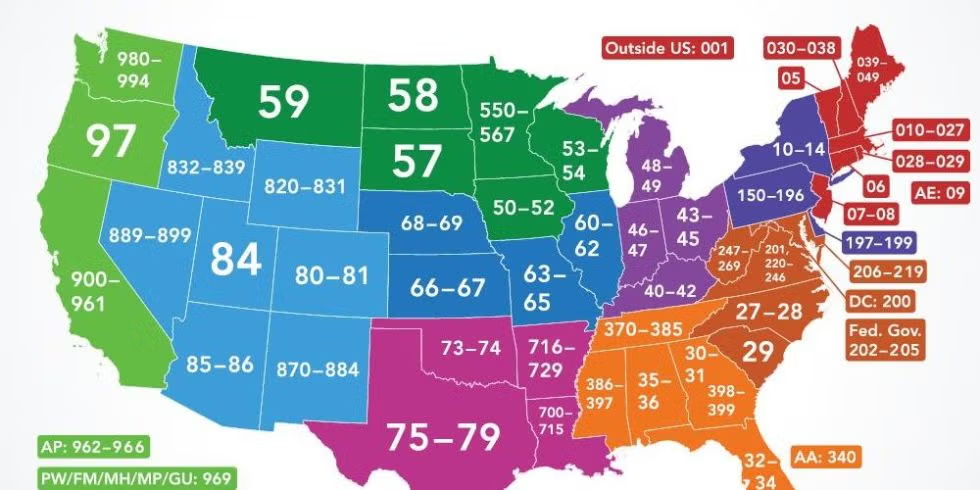
Your ZIP Code Is More Than an Address
When Americans talk about a ZIP Code, it sounds like nothing more than a number used by the postal service.
But location can tell you a lot about the economic environment surrounding a household.
The U.S. Census Bureau uses ZIP Code Tabulation Areas, or ZCTAs, to analyze demographic and housing data geographically. These areas allow researchers to compare things such as income, housing and population characteristics across different parts of the country.
And here’s the interesting part:
Two homes that are only a few miles apart can have dramatically different financial realities.
Different housing prices.
Different property taxes.
Different insurance costs.
Different commuting patterns.
Different school districts.
Different local amenities.
Sometimes, even different perceptions of the neighborhood itself.
The Same Salary Can Buy Two Completely Different Lives
Let’s go back to our hypothetical Americans.
Both earn:
$100,000 per year.
Now imagine:
Person A
Lives in a relatively affordable ZIP Code.
Housing costs are manageable.
The commute is short.
Insurance is reasonable.
There are affordable grocery stores nearby.
The person can save $1,500 every month.
Person B
Lives in a highly desirable ZIP Code.
Rent or mortgage is extremely expensive.
The commute is long.
Parking costs money.
Insurance is higher.
Restaurants and services are more expensive.
The person can save only $300 per month.
Same salary.
Different financial outcome.
That’s the hidden power of location-based cost of living.
Housing Is Usually the Biggest Difference
This is where ZIP Code can become financially brutal.
The U.S. Census Bureau reported that the median monthly cost for homeowners with a mortgage reached $2,035 in 2024nationwide. But the differences between states were enormous: median monthly owner costs were above $3,000 in California and above $3,100 in the District of Columbia.
And those figures aren’t just mortgage payments.
Housing costs can include:
- Mortgage
- Property taxes
- Homeowners insurance
- Utilities
- Maintenance
- HOA fees
- Other housing-related costs
The CFPB also emphasizes that the affordability of a home depends on more than the purchase price, including property taxes, insurance, utilities, maintenance and HOA fees.
So when someone says:
“This house is only $500,000.”
That’s not the complete financial picture.
The ZIP Code can determine what comes after the purchase price.
The ZIP Code Can Change Your Property Tax Bill
Imagine two homes with exactly the same purchase price.
Both cost:
$400,000.
You might assume the financial burden is similar.
Not necessarily.
Property taxes vary by location.
That means the annual cost of owning those two $400,000 homes can be significantly different depending on the local tax environment.
And property taxes aren’t a one-time expense.
They’re recurring.
Every year.
For as long as you own the property.
This is why buyers shouldn’t look only at:
Home price
They should look at:
Total annual cost of ownership.
Insurance Can Also Depend on Where You Live
Here’s another expense people sometimes overlook.
Insurance.
The risk profile of a location can influence property insurance costs.
Flood risk.
Hurricanes.
Wildfires.
Tornadoes.
Severe storms.
Other regional risks.
The Census Bureau found major geographic differences in property insurance costs. In 2023, Florida had the highest median annual property insurance cost for mortgaged homes at $2,273, followed by Louisiana at $2,140 and Oklahoma at $2,041.
So imagine two families buying similarly priced homes.
One lives somewhere with relatively low insurance costs.
The other lives somewhere with significantly higher insurance premiums.
Their mortgages might look similar.
Their total housing costs don’t.
The Hidden Cost of a “Good Neighborhood”
Now we get into something more complicated.
Why are some neighborhoods so much more expensive?
Because people aren’t just buying a house.
They’re buying access.
Access to:
- Schools
- Transportation
- Parks
- Shopping
- Restaurants
- Healthcare
- Employment centers
- Safety
- Amenities
- Community infrastructure
The Census Bureau notes that local data can help prospective homebuyers evaluate factors such as schools, healthcare, public transportation, libraries and shops when deciding where to live.
In other words:
You’re often paying for the ecosystem around the house.
School Districts Can Change the Equation
For families with children, this becomes even more important.
A neighborhood isn’t simply a neighborhood.
It’s often connected to a particular school district.
And school quality can influence where families want to live, which can affect housing demand and prices.
The Census Bureau maintains geographic data on school districts across the country, illustrating just how precisely these boundaries can be defined.
This creates an interesting financial cycle:
Desirable schools → higher demand → higher housing prices → higher cost of living.
For parents, the calculation isn’t simply:
“How much is the house?”
It may be:
“How much am I willing to pay to live in this school district?”
A Cheap House Can Become an Expensive House
Here’s a financial paradox.
Imagine you find a home that’s:
$100,000 cheaper
than another property.
You might think you’ve found the better deal.
But what if the cheaper house is:
45 minutes farther from work?
Now you’re driving more.
You’re using more gas.
You’re putting more miles on your vehicle.
You may need more frequent maintenance.
You may spend more time commuting.
And perhaps you need a second car.
Suddenly, your “cheaper” house isn’t necessarily as cheap as it looked.
This is why cost of living has to include transportation.
The Commute Can Eat Your Salary
Let’s say moving farther away saves you:
$500 per month in housing.
Sounds fantastic.
But the longer commute costs you:
$200 more in fuel.
$100 more in maintenance.
$150 more in tolls and parking.
And perhaps another $100 in transportation-related expenses.
Your $500 housing savings has almost disappeared.
And there’s another cost:
time.
If your commute adds one hour every day, that’s roughly 250 additional hours per year for a typical five-day work schedule.
Your ZIP Code can therefore affect not only your bank account.
It can affect your life.
Why Some Americans Move to Lower-Cost States
This is one reason location decisions can become major financial decisions.
Someone working remotely might have an unusual opportunity:
Keep the same salary while moving somewhere cheaper.
Imagine earning:
$100,000
while living in a place where housing costs are substantially lower.
Your salary didn’t increase.
But your purchasing power did.
That’s one of the most powerful financial effects of geographic arbitrage.
You’re essentially trying to make the same income buy more.
But Moving Isn’t Always the Answer
Of course, lower cost doesn’t automatically mean better.
A cheaper ZIP Code may have:
- Fewer jobs
- Longer distances
- Less public transportation
- Fewer amenities
- Different schools
- Higher insurance risks
- Higher property taxes
- Other hidden costs
That’s why comparing only rent or home prices can be misleading.
The right question is:
“What does my entire life cost here?”
Not:
“How much is my apartment?”
Your ZIP Code Can Influence Your Transportation Strategy
Think about two Americans.
Person A
Lives in a dense urban area.
Walks to restaurants.
Takes public transportation.
Works close to home.
May not need a car.
Person B
Lives in a suburban or rural area.
Drives 30 miles to work.
Needs a vehicle.
Possibly needs two vehicles for a family.
Pays for:
Gas.
Insurance.
Maintenance.
Repairs.
Registration.
Parking.
The second person might have cheaper housing.
But transportation can absorb part of the difference.
This is why housing + transportation is often more meaningful than housing alone when evaluating affordability.
The “Cheap State” Myth
You’ll often see lists online saying:
“These are the cheapest states in America.”
But cheap for whom?
And cheap in what way?
Low housing costs?
Low taxes?
Low insurance?
Low transportation costs?
Low healthcare costs?
Low childcare?
Low groceries?
The cheapest state isn’t necessarily the state with the cheapest house.
It’s the place where your overall financial equation works best.
Your Income Doesn’t Exist in a Vacuum
This is perhaps the biggest lesson.
A $100,000 salary doesn’t have a universal value.
Its purchasing power depends on the environment around it.
Think of income like water.
In one place, $100,000 may fill a large bucket.
In another, the same $100,000 may barely fill half of it.
That’s why comparing salaries without comparing cost of living can produce completely misleading conclusions.
The ZIP Code Wealth Gap
There’s another fascinating dimension.
Neighborhoods don’t just differ in cost.
They can also differ in income, wealth, home values and economic opportunity.
That can create powerful feedback loops.
Higher-income neighborhoods may attract businesses, amenities and investment.
Those improvements can increase demand.
Higher demand can push housing prices upward.
Higher prices can make the area less accessible to lower-income households.
And over time, the economic identity of the neighborhood can become increasingly distinct.
A ZIP Code can therefore become more than a mailing designation.
It can become an economic signal.
The Financial Test Before Moving
Before moving to a new ZIP Code, don’t compare only rent or home prices.
Build a complete monthly comparison.
Housing
Mortgage or rent
Property taxes
Insurance
HOA
Utilities
Maintenance
Transportation
Car payment
Insurance
Gas
Parking
Tolls
Maintenance
Public transportation
Family
Childcare
School-related costs
Activities
Lifestyle
Groceries
Restaurants
Entertainment
Healthcare
Other recurring expenses
Then compare the total monthly cost.
You might discover something surprising.
The ZIP Code with the $500 cheaper apartment could actually cost you more overall.
The Ultimate Question
Here’s the question Americans should perhaps ask before choosing where to live:
“How much does this ZIP Code cost me every month?”
Not just the rent.
Not just the mortgage.
Everything.
Because a neighborhood can quietly influence dozens of financial decisions.
Where you work.
How far you commute.
What kind of car you need.
How much you pay for housing.
What insurance costs.
Which schools are available.
How much you spend on entertainment.
Even how much time you have available to work, exercise, relax or spend with your family.
Final Thought
Your ZIP Code isn’t just a number on an envelope.
It can be part of your financial strategy.
Two Americans can earn the same salary and have dramatically different financial lives simply because they live in different places.
One may spend thousands more each year on housing.
Another may spend more on transportation.
Another may face higher insurance costs.
Another may pay a premium for access to highly sought-after schools and amenities.
And another may deliberately choose a lower-cost location to maximize savings and investing.
That’s why the smartest question isn’t:
“How much money do I make?”
It’s:
“How much does it cost to live the life I want where I live?”
Because sometimes the easiest way to improve your finances isn’t getting a bigger paycheck.
It’s choosing a place where your existing paycheck goes further.